
Tag: publications
-

Data and Feminicide course students write about their experiences
When the Data and Feminicide: Theory and Practice course ended, we invited students to write about their experiences. The resulting articles were published as a series in the Data + Feminism Lab blog at Medium. From Digital Hate to Deadly Violence: Online Abuse, Antifeminism, and Feminicide in Germany Grit Marti Lange, Natalia Mejia Pardo, and…
-
Towards Justice-Oriented AI: Reflections on a Research-Community Partnership to Co-Develop Swahili AI Tools (Légitime et al., 2026)
AI development is notoriously centralized, concentrating power in the hands of a few. Justice-oriented frameworks have emerged to challenge this paradigm, but documented examples of AI projects that aim to distribute power and ownership across the full development lifecycle remain rare. In this paper, co-authors from a Kenyan activist organization that monitors femicide in the…
-
Data activism and artificial intelligence (AI) technologies in the struggle against feminicide in Brazil (Jungs de Almeida et al., 2026)
In this text, we present data activism practices against feminicide in Brazil, highlighting the collaborative project Data Against Feminicide and the work of feminist organizations that produce, monitor, and use data to combat lethal gender-related violence. In response to state neglect and the lack of reliable official data, these initiatives work to make feminicide visible…
-
Data Against Feminicide: Confronting Stereotypes and Silences with Feminist Data Work (Fumega, 2026)
This chapter explores how DcF operates as a community of practice that challenges dominant knowledge systems, confronts harmful media narratives, and proposes alternative, care-based approaches to security through feminist data infrastructures. The sections that follow examine how these practices unfold in greater depth: from DcF’s foundational approach to community building and collective care, to its…
-
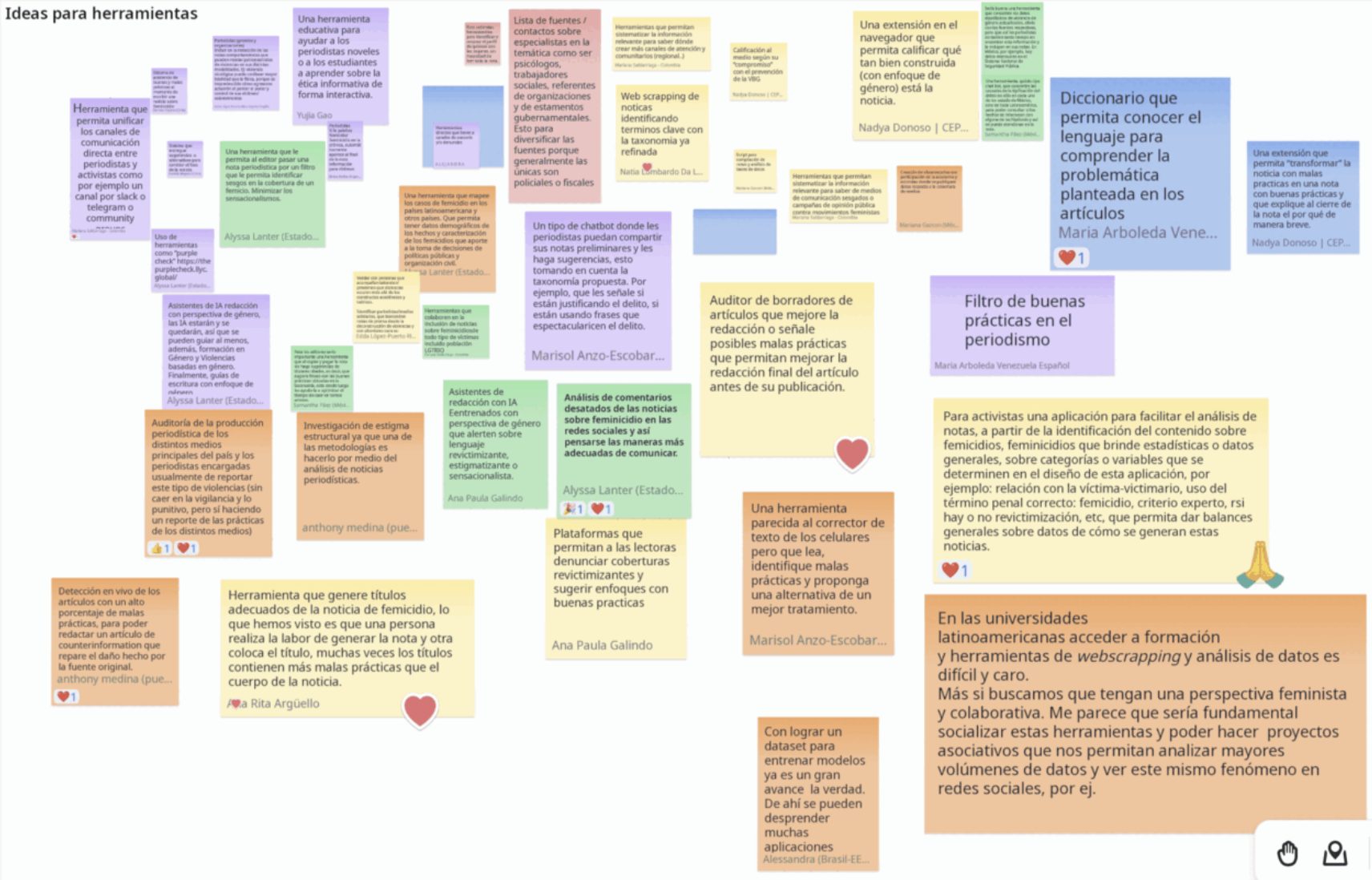
Reimagining Data Work: Participatory Annotation Workshops as Feminist Practice (Gao et al., 2026)
AI systems depend on the invisible and undervalued labor of data workers, who are often treated as interchangeable units rather than collaborators with meaningful expertise. Critical scholars and practitioners have proposed alternative principles for data work, but few empirical studies examine how to enact them in practice. This paper bridges this gap through a case…
-
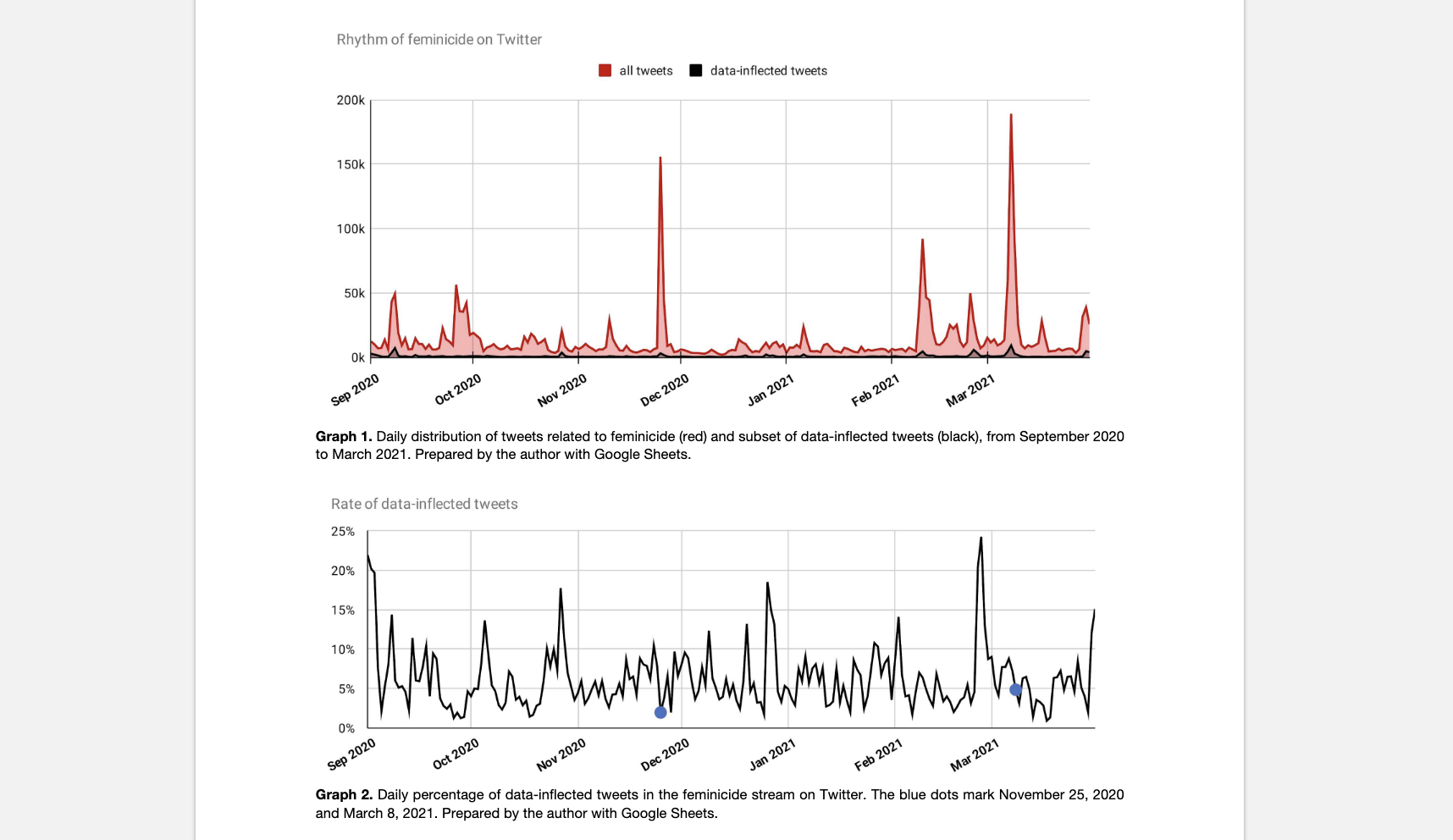
Dwelling with feminicide data: Digital methods for feminist research (Suárez Val, 2025)
This paper presents an innovative digital research methodology that imbricates feminist, participatory, and computational epistemologies to research the role of data in social contestation. Focusing on the social media conversation about feminicide, specifically on Spanish-speaking Twitter (now X), the study examined a dataset of 2.86 million posts to find which emotions and actions are involved…
-

Data-Inflected Visions of Feminicide (Suárez Val, 2025)
This paper advances the notion of “data-inflected visions” to show how various visual representations may come come to be imagined as data, and how doing so opens up different meanings for the political and affective work of data. The visuality of social issues is produced through competing hegemonic and alternative visions, and conventional visualization is…
-
Data Activism Against Feminicide (Cruxên & Jungs de Almeida, 2024)
What role does data play in addressing gender-based violence? This report summarizes the results of five years of collective work as part of the Data Against Feminicide project. Data Against Feminicide is a South-North participatory action research and design project that supports the work of activists and civil society organizations that produce data on gender-based…
-

Counting Feminicide: Data Feminism in Action (D’Ignazio, 2024)
What isn’t counted doesn’t count. And dominant institutions systematically fail to account for feminicide, the gender-based murder of women and girls, including cisgender and transgender women. In the face of this failure, Counting Feminicide foregrounds the work of data activists across the Americas who are documenting these kinds of murders and challenging the reigning logic…
-
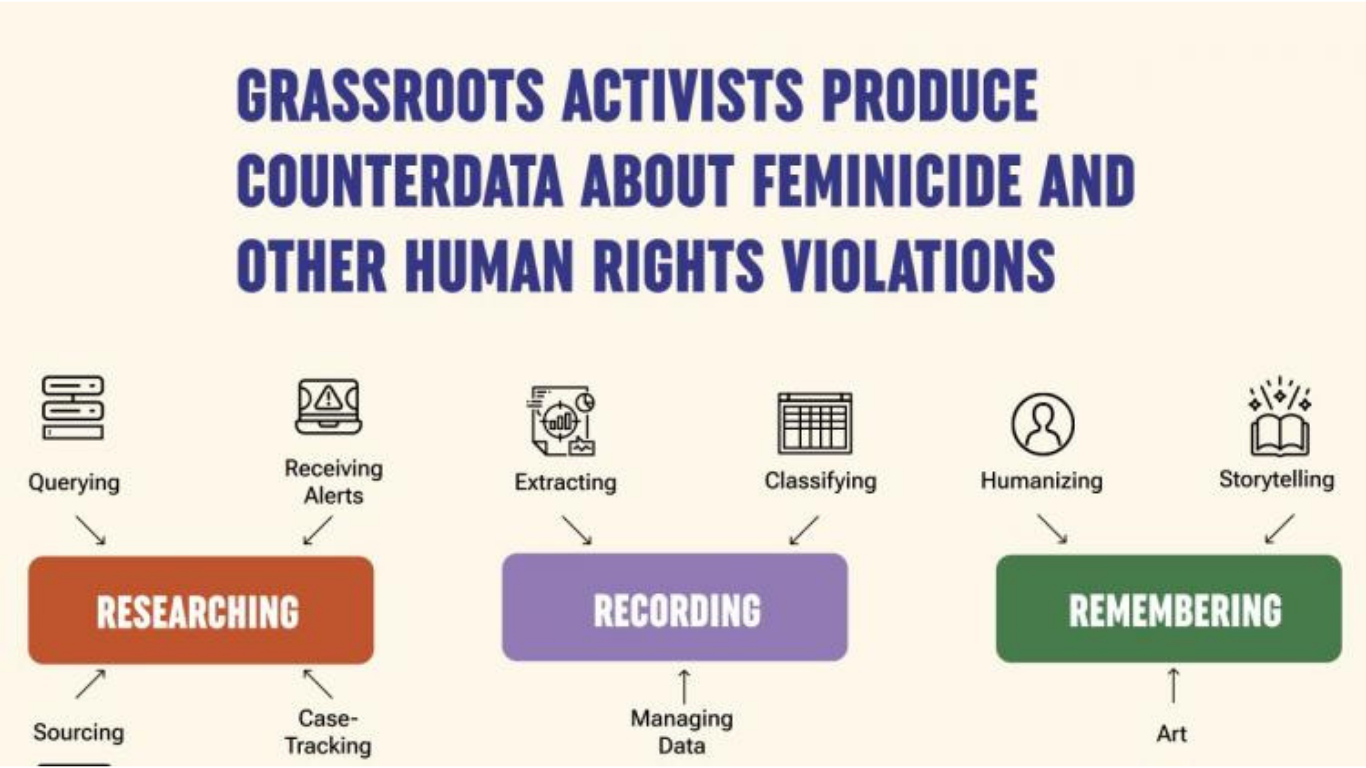
Feminicide and counterdata production: Activist efforts to monitor and challenge gender-related violence (D’Ignazio et al, 2022)
Gender-based violence against women and its lethal consequence, femicide, are a serious problem worldwide. Official government data on gender-based violence and femicide are often absent, incomplete, infrequently updated, and contested. We draw on data feminism to situate femicide data as missing data. Drawing on qualitative interviews, this study analyzes the informatics work of ten activist…