
Author: ladelentes@gmail.com
-
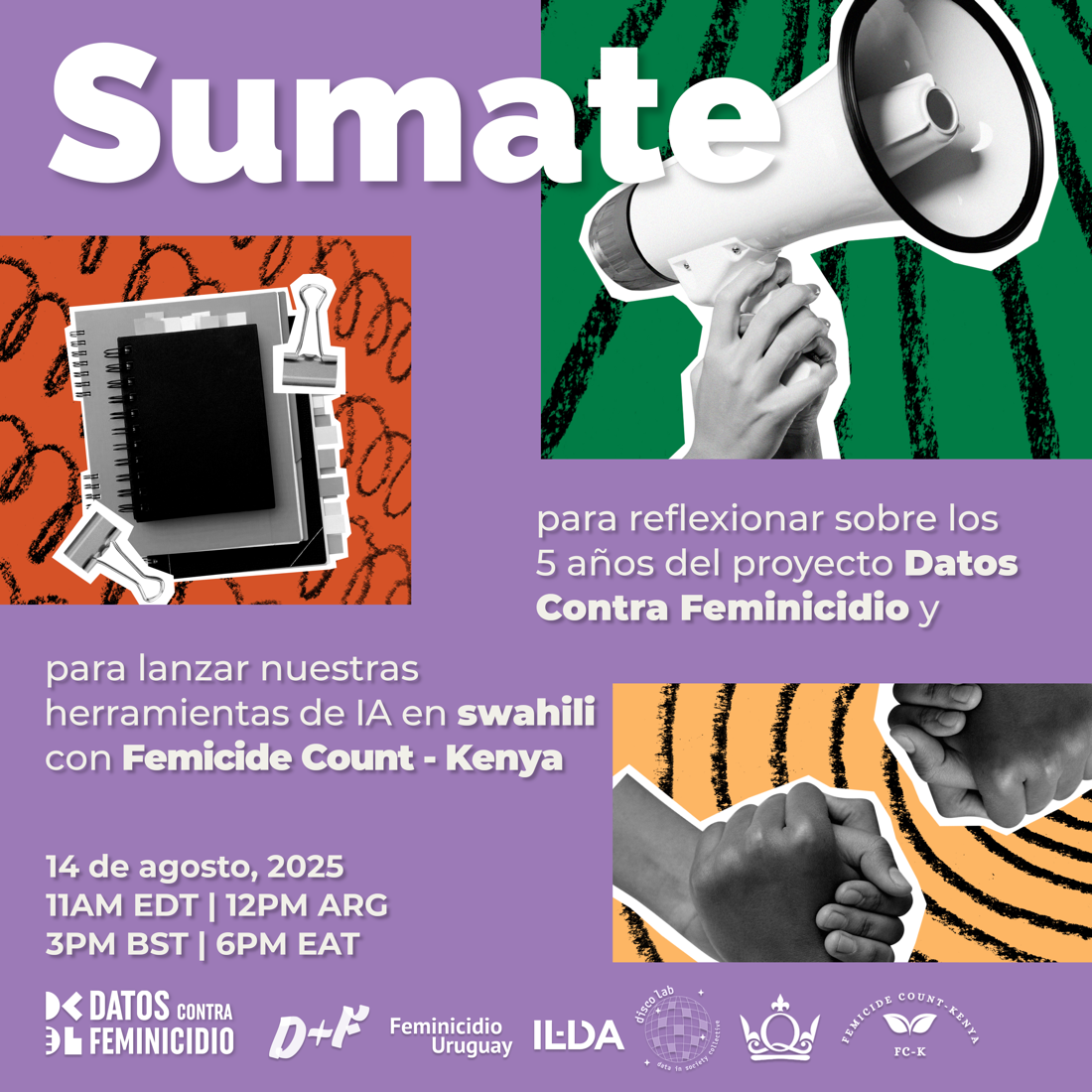
Join us to celebrate 5 years of Data Against Feminicide + tools in Swahili!
This year we celebrate five years since we started the Data Against Feminicide project. To look back on all we have done together, join us to reflect on the learnings and insights from the project and to launch the Swahili version of our tools, co-designed with the amazing Femicide Count Kenya. August 14, 202511AM EDT / 12PM ARG /…
-

Data-Inflected Visions of Feminicide (Suárez Val, 2025)
This paper advances the notion of “data-inflected visions” to show how various visual representations may come come to be imagined as data, and how doing so opens up different meanings for the political and affective work of data. The visuality of social issues is produced through competing hegemonic and alternative visions, and conventional visualization is…
-
Data Activism Against Feminicide (Cruxên & Jungs de Almeida, 2024)
What role does data play in addressing gender-based violence? This report summarizes the results of five years of collective work as part of the Data Against Feminicide project. Data Against Feminicide is a South-North participatory action research and design project that supports the work of activists and civil society organizations that produce data on gender-based…
-
Missing data and counterdata (Cruxên et al, 2024)
Cruxên, I., Jungs de Almeida, A., Klein, L. F., & D’Ignazio, C. (2024). Dados Ausentes e Contradados. Em S. Mariano (Ed.), Informe Feminicídios no Brasil 2023: Monitor de Feminicídios no Brasil. Márcio Ferreira de Souza. https://dspace.mit.edu/handle/1721.1/157846?show=full O Monitor de Feminicídios no Brasil (MFB) é uma iniciativa do Laboratório de Estudos de Feminicídios no Brasil, formado…
-
Challenging (in)security: Missing Data and Counterdata Production on Feminicides in the Americas (Jungs de Almeida et al, forthcoming)
Jungs de Almeida, A., Cruxên, I., Radhakrishnan, R., & D’Ignazio, C. (forthcoming). Challenging (in)security: Missing Data and Counterdata Production on Feminicides in the Americas. En P. Anctil (Ed.), Feminist Security Studies in the Americas: Pushing the Fronteras. Palgrave Macmillan. Enlace externo
-

The revolution shall not be automated: On the political possibilities of activism through data & AI (Cruxên, 2024)
Reflecting on the “AI revolution”, Isadora Cruxên draws on her experience working with activists in the collaborative project Data Against Feminicide to argue that the politics of data and AI is, at heart, a politics of knowledge production. She invites us all to take part in this conversation. Cruxên, I. (2024, mayo 28). The revolution…
-
Technology and Anti-Feminicide Data Activists (Jungs de Almeida et al, 2023)
Data Against Feminicide project collaborates with Brazilian civil society organizations to develop digital technologies to support the struggle against feminicide. Jungs de Almeida, A., D’Ignazio, C., França, C., Cruxên, I., Kalil, M. E. X., Marques, R., Mariano, S., Negrão, T., & Siqueira, T. P. (2023, agosto 30). Tecnologia e Ativistas de Dados Contra o Feminicídio.…
-
Feminicide Data Activism (Collectif Féminicides Par Compagnons ou Ex at al, 2023)
This chapter weaves together, as nodes in a network of care, the experiences of activists collecting feminicide data in France, Germany, Kenya, Kyrgyzstan, Mexico, Russia, the United States, and Venezuela. In our work, we draw from a long genealogy of feminist research and activism on femicide/feminicide and gender-related violence. To contextualise our practices, we draw…
-
Latin American standardisation of data on feminicide (Fumega et al, 2023)
This chapter presents the results of a participatory action-research strategy that led to the creation of a feminicide data standard. In response to the lack of homogenisation in data collection of feminicide across the region, ILDA has worked in different contexts and with different partners throughout two iterations of the feminicide data standard project. In…
-
Human-Centered Computing and Feminicide Counterdata Science (D’Ignazio, 2023)
Data about feminicide can be conceived as missing data – data that are neglected by authorities and underreported in official registries. Activists and civil society groups in Latin America and beyond are increasingly stepping into these gendered data gaps to undertake feminist counterdata science – an explicit challenge to the inadequate data practices of governments…